
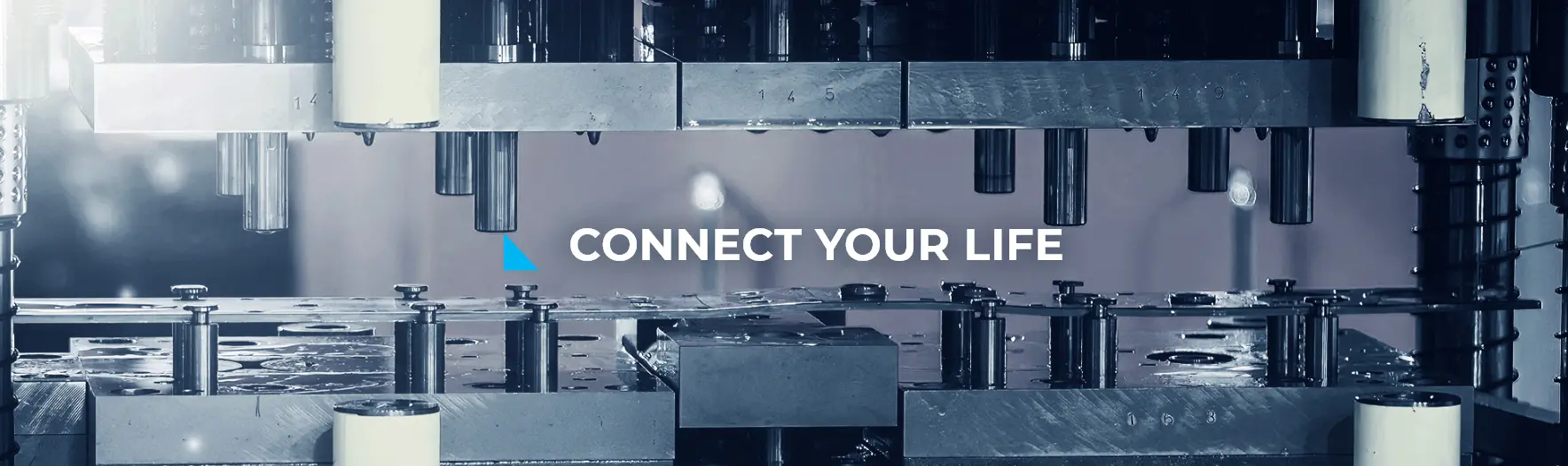
Stamping Die Design Explained: Process and Key Principles
 Metal stamping is the backbone of modern manufacturing, and in the realm of precision metal stamping, die design is the defining factor that determines product accuracy, efficiency, and cost. An expertly designed die not only extends tool life but also enhances process stability, reducing defect rates at the source.
This guide covers the fundamentals, key design processes, and material selection principles to help manufacturers master the core technologies of competitive stamping.
The Strategic Impact of Die Design
In precision metal stamping, the die design defines the ceiling of both product quality and production efficiency. A robust design ensures:
- Dimensional Stability: By anticipating material behavior and stress, expert design secures ultra-tight tolerances over millions of cycles.
- Cost-Efficiency: Optimized layouts maximize material yield and Strokes Per Minute (SPM) while drastically reducing maintenance downtime.
Ultimately, prioritizing design integrity at the source is the most effective way to transform complex engineering into stable, high-volume reality.
What is a Stamping Die?
Definition & Function
A stamping die is a precision cold-working tool mounted on a press machine. It works by applying vertical pressure to force metal into Separation (Shearing) or Plastic Deformation to form parts. High-quality die design ensures consistent dimensional accuracy over millions of cycles and significantly reduces maintenance downtime.
Structure of a Stamping Die
While custom to every product, a standard precision die relies on three core systems:
- Guidance System: (Outer/Inner Guide Posts) Acts as the die's "tracks," ensuring precise alignment during high-speed closure to prevent edge wear.
- Positioning System: (Dowel Pins) Locks plates to absolute coordinates, ensuring zero-error alignment of internal mechanisms.
- Working Mechanism: (Punches & Die Inserts) The active components that directly contact the material to cut, pierce, or form the part.
Anatomy of a Standard Stamping Die
Explanation
- Outer Guide Post
- Dowel Pins for Upper and Lower Plate Groups (Positioning Pins)
- Punching Mechanism (or Piercing Unit)
- Bending Mechanism (or Bending Unit)
- Inner Guide Post
Common Types of Stamping Dies
Dies are categorized by their level of process integration:
- Single Station Die: Executes one process (e.g., blanking or bending) per stroke. Simple and low-cost, but labor-intensive with lower efficiency. Best for small batches or large workpieces.▲ These are compact machines specifically used for single station die metal stamping applications.
- Progressive Die: Integrates multiple processes (piercing, bending, forming) into a single die, using a metal strip to feed material automatically. This is the ideal solution for mass-producing precision electronic components with high efficiency and stability.
The Stamping Die Design Process
Professional design bridges the gap between 3D concepts and stable mass production by merging digital engineering with physical validation to minimize risk and cost.
Phase 1: DFM & Drawing Review
Each drawing undergoes a comprehensive DFM (Design for Manufacturability) analysis to ensure part features align with production capabilities:
- Tolerance Strategy: Targets the "mean value" for unidirectional tolerances (e.g., -0.25mm for a +0/-0.5mm limit) to compensate for natural tool wear. Precision can reach 0.001mm.
- Geometry Optimization: Confirms the Bending Radius (R) is equal to or greater than material thickness and Punch Diameters exceed thickness to prevent breakage.
- Material Analysis: Calculates Springback Compensation and the K-Factor based on material elongation and tensile strength.
For more detailed information about our project development process, please refer to the link below:
Project Development Process
Phase 2: Strip Layout & Scheme Selection
This stage defines material utilization and production logic:
- Tooling Choice: Progressive Dies are typically utilized for high volumes (>50k units), while Compound Dies are reserved for high-flatness requirements.
- Nesting & Piloting: Optimizes material yield and integrates precision Piloting systems to ensure feeding accuracy at high speeds.
- Idle Stations:Reserved stations allow for future Engineering Change Notices (ECN) without requiring a complete die rebuild.
Phase 3: CAE Simulation & Virtual Try-out
CAE (Computer-Aided Engineering) Software is used to simulate the stamping process before manufacturing:
- Risk Mitigation: Identifies potential cracks, wrinkling, or excessive thinning in a virtual environment.
- Efficiency: Optimizes pressure distribution and R-angles digitally, significantly reducing physical trial-and-error costs.
Phase 4: Precision Manufacturing & Heat Treatment
High-performance components require specialized processing:
- Advanced Machining: Combines Computer Numerical Control (CNC) milling, Electrical Discharge Machining (EDM)—including Wire EDM—and precision grinding to achieve exact specifications.
- Surface Treatment: Employs Vacuum Heat Treatment for core toughness and Nitriding or specialized coatings to enhance punch wear resistance.
Phase 5: T0/T1 Verification & CPK Validation
Verification ensures the die meets both geometric and stability standards:
- Micro-adjustments: Fine-tunes die geometry based on real-world springback observed during initial trials.
- Process Capability: Uses CPK (Process Capability Index) analysis through continuous sampling to ensure dimensional stability across millions of cycles.
Phase 6: Lifecycle & Maintenance SOP
Strategic maintenance preserves the die as a long-term asset:
- Predictive Monitoring: Optional sensors track stamping forces to detect tool wear before defects occur.
- Maintenance Protocol: A "Die History" log tracks performance, scheduling sharpening and lubrication every 100k cycles to maximize service life.
▲ Ming Chiang regularly maintains stamping dies in advance to prevent issues and ensure smooth operation.
Material Selection & Heat Treatment Strategy
Die life depends on the "Right Material for the Right Place"—balancing Hardness and Toughness.
Die Set System: Shock Absorption
The die set acts as a shock-absorbing foundation, typically utilizing S50C (Medium Carbon Steel) without heat treatment. Its inherent toughness absorbs vibration during operation, effectively protecting the press spindle and internal precision components from direct impact damage.
Structural Support Plates: Rigidity
For backing and punch plates requiring high compressive strength, SKD11 (Cold Work Tool Steel) heat-treated to HRC 58-60 is the standard choice. This high hardness ensures the plates provide rigid support and resist deformation or indentation under sustained heavy loads.
Forming & Stripping Areas: Toughness Balance
For components facing repeated impact, such as stripper and die plates, SLD (Modified Tool Steel) at HRC 58-60 is preferred over more brittle alternatives. SLD maintains high hardness while offering superior toughness, effectively preventing chipping or cracking in complex die sections.
Core Punches & Inserts: Extreme Wear Resistance
Core punches and inserts utilize SKH9 (High-Speed Steel) heat-treated to HRC 60-62 to withstand high frictional heat. Its superior "Red Hardness" ensures cutting edges remain sharp and durable throughout millions of high-speed production cycles.
| Component | Recommended Material | Hardness (HRC) | Key Principle |
|---|---|---|---|
| Die Set Base | S50C | - | Shock Absorption: Dampens vibrations to safeguard the press spindle and internal precision parts. |
| Support Plates | SKD11 | 58–60 | Rigidity & Anti-Deformation: Resists surface indentation and structural warping under sustained heavy loads. |
| Stripper / Die Plate | SLD | 58–60 | Toughness & Anti-Chipping: Prevents fractures or edge chipping in complex sections during repeated impacts. |
| Punch & Insert | SKH9 | 60–62 | Extreme Wear Resistance: Maintains edge integrity and resists abrasion under intense frictional heat. |
▲ Ming Chiang's stamping dies consist of multiple plates, each made from different materials and manufactured using different processes.
Design Principles
For precision stamping of thin-to-medium gauge materials (0.05mm - 5.0mm), the spring system is critical not just for return, but for "Holding" and "Stripping."
Selection of Spring Type
- Standard Application: For general precision stamping, standard Alloy Steel Coil Springs provide sufficient load and response speed with low maintenance costs.
- Special Cases: Nitrogen (Gas) Springs are considered only when dealing with extremely thick materials or severely limited space.
Stroke Calculation & Force Balance
- Stroke: Calculations must ensure the spring never reaches its "Solid Height" to prevent die damage.
- Force Balance: Spring force is typically set at 10%~20% of the shearing force.
- Too Low: Fails to hold material, causing slippage and dimensional instability.
- Too High: May cause "Die Lifting," disrupting the bending angle.
Fatigue Management & Preventive Maintenance
Springs are dynamic consumables. Mass production requires a "Preventive Replacement" protocol (e.g., every 100k cycles or based on compression ratio). Springs should be measured and replaced upon signs of fatigue, rather than waiting for failure.
FAQ
Q1: How are die maintenance standards typically established in the industry?
A: Through a "Preventive Maintenance" strategy driven by two indicators:
- Periodic Checks: Disassembly and inspection at fixed intervals (e.g., 100k hits).
- Dynamic Monitoring: If IPQC (In-Process Quality Control) detects dimensions approaching warning limits (e.g., 0.03mm vs 0.05mm tolerance), regrinding is triggered immediately.
Q2: How do I decide between a Progressive Die and a Single Station Die?
A: It’s a trade-off between Cost and Volume.
- Progressive Die: Higher tooling cost, but lowest unit price. Ideal for high-volume mass production.
- Single Station Die: Lower tooling cost, higher labor cost. Best for prototypes or small batches.
Conclusion
Stamping die design is the engineering art of balancing precision, longevity, and cost. From DFM to material strategy, every step impacts competitiveness. Partnering with a manufacturer capable of full-cycle development ensures risks are mitigated at the source, achieving high quality and efficiency.
Experience the difference! Ming Chiang Precision goes beyond standard validation—refining T0/T1 samples until they meet your exact specifications. With flexible pilot runs of 50–500 pieces, we ensure a seamless transition from prototype to mass production.
Ready to secure precision for your project? Explore our precision stamping and mold manufacturing solutions or contact us today. Partner with Ming Chiang Precision – your reliable high-volume metal stamping supplier for automotive modules.